

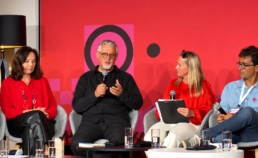
At the Frankfurt Book Fair this year, AI is no longer the elephant in the room. Writers are.
The Frankfurt Book Fair, or Buchmesse as Germans fondly call it, is the largest book trade fair in the world, both by the sheer number of publishers and professionals who attend and by its weight in the business of publishing, distributing and selling books. I have been attending for decades as part of my work with Visiontime, and when I eventually launched a successful writing career, attending as an author disguised as a publishing professional became the ultimate perk. Frankfurt is where the book world’s biggest deals are inked, its most seismic announcements made and its most cutting-edge innovations unveiled.
Today was the opening day of the 2026 edition, and apart from the freakishly warm weather, which made Frankfurt feel more like Rome in October, two things were impossible to ignore.
The first, unsurprisingly, is the omnipresent ghost of artificial intelligence, which has unapologetically hijacked this year’s fair. Two years ago, AI was merely the elephant in the room. This year, every panel and presentation either focused explicitly on the threat or the promise of AI in publishing, or veered in that direction regardless. Amira Abul Magd of the Egyptian publisher Dar El Shorouk summed up the hot mess that is AI in publishing when she asked a panel on future skills for publishing professionals whether it is even the responsibility of publishers to police their authors’ use of generative AI, or whether doing so would serve any purpose.
The second thing you couldn’t miss was, counterintuitively, that the voices of authors and other creatives were almost entirely absent from this discussion. Granted, Frankfurt has never paid much attention to authors other than in a ceremonial capacity. It bills itself as the center of gravity of the business of publishing, and other fairs, such as London, do a much better job of engaging with the creative side of the book equation.
What makes this year’s underrepresentation of publishing’s creative heart an anomaly is the corresponding overrepresentation of hysteria, in which AI is cast, in the same breath, as an existential threat to writing and reading and as the biggest innovation to touch human culture since the printing press.
I am happy to listen to household-name publishers, analysts, marketing experts, academics and journalists prognosticate about the future of writing, both as a profession and as a bastion of culture. But without the voices of those who actually do the writing, it feels like a doctor asking a patient’s family, friends and colleagues about their health without ever asking the patient how they feel.
I asked Nigel Newton, the founder of Bloomsbury Publishing Plc, whether Bloomsbury engages in any meaningful way with its authors about the impact of AI on their profession, and whether those conversations filter up and shape how the company does business.
I have great respect for Nigel and for what he has built. Bloomsbury is the original gangster of author-centric, fiercely independent publishers, one whose core strategy has always been to compete with far larger corporate conglomerates. So I wasn’t surprised when he confirmed that they do engage with their authors about the future of the industry, in ways that can inform the company’s governance. I wonder whether the same can be said of the Big Five, Penguin Random House, HarperCollins, Simon & Schuster, Hachette Book Group and Macmillan, which between them control roughly 80% of the US trade book market.
I suspect that most writers, if asked, would say something very close to what I am about to tell you.
If you are an established writer with a confident narrative voice and style, you are unlikely to be losing sleep over AI rendering you obsolete. That isn’t down to some haughty moral argument, such as “readers will always prefer a human over a machine,” but to a far more material truth about how large language models work.
A language model learns by averaging; a writer becomes themselves by refusing to. A model could absorb every page of my thriller Terminal Rage, from the terrorists seizing a Manhattan skyscraper to the final twist, and reproduce its pacing, but not the reasons behind it.
Consider this. I am an Egyptian writer raised in a diplomatic family. I have lived in more than fifteen countries, and I came to fiction from film sets. Run those odds and the pool narrows to almost nothing. There may be no one else alive with that exact mix of places, postings and production credits. Fewer still would have turned it into a writing life, and of those, who would have chosen espionage and political thrillers? I am, in effect, a statistical impossibility, and so is every serious writer, each in their own way.
That is why the scenes in which American negotiators haggle with Egypt’s post-Mubarak generals carry the dry, knowing humor of someone who grew up watching that kind of politics up close. It is why the Egyptian prison in the book comes from memory and stories overheard rather than research. It is why I could write my villain, Seth, from the inside rather than from across a border, and why the book cuts from New York to Cairo to Rome like the work of someone who learned to tell stories in an editing room.
I learned this the practical way, by experimenting with generative AI to see what the hype was about. I fed Claude, ChatGPT and Gemini sample chapters of my published work and asked them to improve them. And yes, the prose came back leaner, sexier, more confident, whatever I asked for. But it was never me. Every version read like a talented stranger doing an impression of me, and not one of them was something I would want my name on.
Every writer carries DNA like this, and readers are remarkably intuitive about it. What keeps them coming back is rarely the big hit, the twist or the entertainment payload. It is the spaces in between, the thing they can feel but can’t quite name: the way a writer makes them feel something, because the writer felt it first. A model predicts the probable next word, and a writer’s fingerprint lives in the improbable one. It can polish the voice I bring to it, but it cannot supply the life that made that voice.
And that speaks to another truth that most artists have already figured out, but the rest of the creative industries have not. Assuming that generative AI will take over culture gives very little credit to the public. It assumes audiences come to art only for the visceral pleasure it provides: a thriller for a few hours of escape, a painting to brighten a room, a television series to binge, with no emotional connection to the artist behind it. In fact, audiences do care about creators as much as they care about their creations.
This is what most writers want you to know. Instead of getting knotted up about the death of human culture at the hands of generative AI, writers would much rather the industry used AI to solve some of publishing’s age-old problems. Speaking today on a panel aptly titled “AI in Culture: Truth or Fiction?” Nadim Sadek of Shimmr AI described his work using AI to crack publishing’s Holy Grail, discoverability, in a way that could democratize how readers find books tailored to their tastes in an age of superabundance that generative AI will only intensify.
That is the conversation I wish had filled more of the halls today. The flood of books is coming either way, and plenty of them will be machine-made. A machine may well help a reader find the right book in that flood. What it cannot do is write the book that a reader falls in love with, because that book depends on someone having lived it first.
So next year, when Frankfurt convenes its panels on the future of writing, I hope it tries something radical. Ask the patient.
#FBM26 #FrankfurterBuchmesse #LondonBookFair #Publishing #AI #AmWriting