

Stop Writing What Everyone Else Has Already Written
There’s a particular kind of sentence that slips past both writer and reader without resistance. It does its job, carries meaning, and then disappears without leaving a trace. On the surface, that sounds like efficiency. In practice, it’s one of the quiet killers of good fiction.
I’m talking about idioms. Clichés. Those familiar turns of phrase that feel comfortable because we’ve heard them a thousand times before.
“At the end of the day.”
“Her heart skipped a beat.”
“Back to the drawing board.”
They’re not wrong. They’re not even poorly constructed. But they come preloaded with meaning that doesn’t belong to you. And that’s the problem.
When I write a thriller, I’m not just trying to move a story forward. I’m trying to create tension that feels immediate, specific, and lived-in. The reader shouldn’t feel like they’ve read this before, even if the underlying situation is familiar. The moment you lean on a stock phrase, you surrender that edge.
Let’s be honest. Idioms are tempting because they’re efficient. “Heart skipped a beat” instantly signals fear or attraction. It’s shorthand. But it’s also lazy shorthand. It tells the reader what to feel without making them experience it.
Compare that to something concrete. A character walks into a room and sees someone they didn’t expect. You could write:
“His heart skipped a beat.”
Or you could write:
“He stopped just inside the doorway, hand still on the handle, as if the room had shifted and he needed a second to find his balance.”
The second takes more effort. It’s less tidy. But it belongs to you. It creates a moment rather than referencing one.
That distinction matters more than most writers realize.
Readers don’t consciously think, “Ah, that’s a cliché.” What they feel is something subtler. A slight disengagement. A sense that the prose is on autopilot. Multiply that across a chapter, and you lose tension without ever noticing why.
Thrillers, in particular, can’t afford that.
This genre runs on momentum and immersion. If the language becomes generic, the stakes start to feel generic too. Suddenly the danger isn’t immediate. The characters aren’t fully real. The entire narrative drifts half a step away from the reader.
And it often starts with small phrases.
“Calm before the storm.”
“Scared to death.”
“Needle in a haystack.”
Each one is a shortcut. Each one replaces observation with assumption.
Now, I’m not suggesting you purge every idiom from your writing. That’s a different kind of mistake. Language without any shared expressions can feel unnatural, even artificial. People do speak in idioms. They use them in conversation, often without thinking.
So the real question isn’t “Should you use them?” It’s “Where and why?”
Dialogue is one place where idioms can work. If a character would realistically say, “We’re back to square one,” then forcing them to speak in perfectly original phrasing will sound false. Voice matters more than novelty in those cases.
But narration is different. Narration is where your authority as a writer lives. It’s where tone is established, where atmosphere is built, where the reader decides whether to trust you.
If your narrative voice leans on clichés, it signals something you don’t want to signal: that you’re relying on inherited language instead of observed reality.
There’s also a second, more strategic use of idioms that’s worth mentioning. You can use them deliberately and then break them.
For example:
“It was the calm before the storm. The only problem was, the storm had already started, and nobody in the room seemed to notice.”
Now the cliché becomes a setup rather than the endpoint. It draws on familiarity, then undermines it. That creates tension instead of draining it.
But again, that only works if it’s intentional.
Most of the time, clichés creep in unnoticed. They’re habits. Default settings. You write quickly, the phrase appears, and you move on.
This is where discipline comes in.
When you revise, you need to read with a different eye. Not just for plot holes or pacing, but for language that feels too easy. Too smooth. Too familiar.
A useful test is simple: could this sentence appear in a hundred other novels without anyone noticing? If the answer is yes, it probably doesn’t belong.
Another test is to ask whether the phrase is doing any real work. Is it creating an image? Is it revealing something about the character? Is it adding tension?
Or is it just filling space between two plot points?
If it’s the latter, cut it or replace it.
This doesn’t mean every line needs to be lyrical or complex. In fact, thriller writing often benefits from restraint. Short sentences. Clean structure. Forward motion.
But simplicity is not the same as generic language.
You can write plainly and still be precise. You can write quickly and still be original.
“He was very angry” is plain, but flat.
“He crushed the glass in his hand without noticing the blood” is still simple, but it carries weight.
The difference is specificity.
And that’s what clichés strip away.
They replace the specific with the general. The observed with the assumed. The immediate with the familiar.
If you want your writing to stand out, you don’t need more complicated vocabulary or elaborate metaphors. You need to pay closer attention to what you’re actually describing.
What does fear look like in this moment, for this character?
What does tension feel like in this room, right now?
What small, physical detail can carry that emotion without naming it?
Answer those questions, and the clichés take care of themselves. They fall away because you no longer need them.
That’s the goal.
Not to write something that sounds impressive, but to write something that feels real enough that the reader forgets they’re reading at all.
And that only happens when the language is yours.
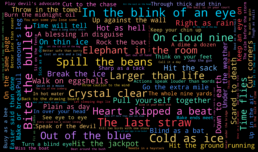
Here are 100 of the most overused clichés in fiction. I keep this list close when I write, not as a set of rules, but as a reminder to stay honest with the language.
- At the end of the day
- Back to the drawing board
- Think outside the box
- Hit the ground running
- Go the extra mile
- Take it to the next level
- When push comes to shove
- The calm before the storm
- The last straw
- Add fuel to the fire
- Heart skipped a beat
- Scared to death
- Cold as ice
- Hot as hell
- In the blink of an eye
- Time will tell
- Easier said than done
- Actions speak louder than words
- Better late than never
- Better safe than sorry
- Bite the bullet
- Break the ice
- Cut corners
- Hit the nail on the head
- Let the cat out of the bag
- Spill the beans
- Under the weather
- Cost an arm and a leg
- Once in a blue moon
- Burn the midnight oil
- Needle in a haystack
- On the same page
- Up in the air
- The ball is in your court
- Kill two birds with one stone
- A blessing in disguise
- Beat around the bush
- Bite off more than you can chew
- Call it a day
- Cut to the chase
- Get out of hand
- Give it your best shot
- In hot water
- Miss the boat
- Pull someone’s leg
- Sit on the fence
- Speak of the devil
- Take it with a grain of salt
- Throw in the towel
- Through thick and thin
- Jump the gun
- Hit the sack
- Keep an eye on
- Make a long story short
- No pain, no gain
- On thin ice
- Out of the blue
- Play devil’s advocate
- Put all your eggs in one basket
- See eye to eye
- The whole nine yards
- Think on your feet
- Time flies
- You can’t judge a book by its cover
- A dime a dozen
- Every cloud has a silver lining
- Hit the jackpot
- In the nick of time
- Let sleeping dogs lie
- Make ends meet
- Pull yourself together
- Rock the boat
- The tip of the iceberg
- Throw caution to the wind
- Turn a blind eye
- Up against the wall
- Walk on eggshells
- Water under the bridge
- Wear your heart on your sleeve
- You win some, you lose some
- Dead as a doornail
- Crystal clear
- Larger than life
- Plain as day
- Right as rain
- Sick as a dog
- Fit as a fiddle
- Busy as a bee
- Blind as a bat
- Quiet as a mouse
- Sharp as a tack
- Tough as nails
- Light at the end of the tunnel
- Elephant in the room
- On cloud nine
- Down to earth
- In over your head
- Keep your chin up
- Lose track of time
- Make or break